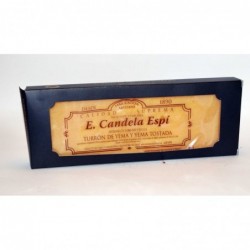
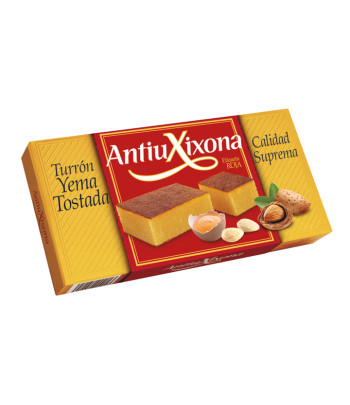
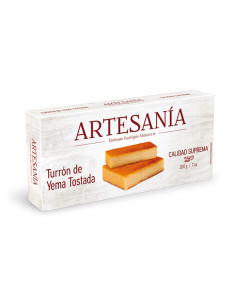
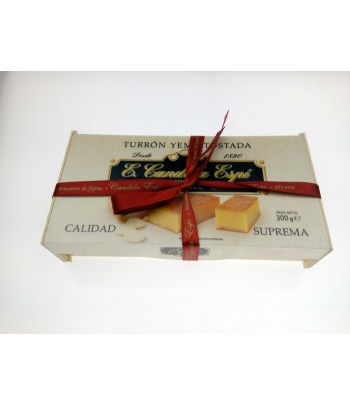
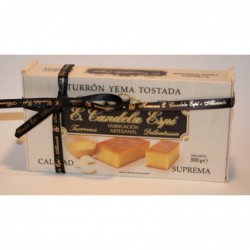
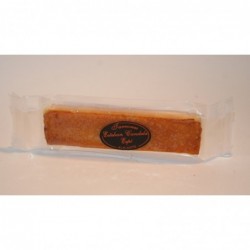
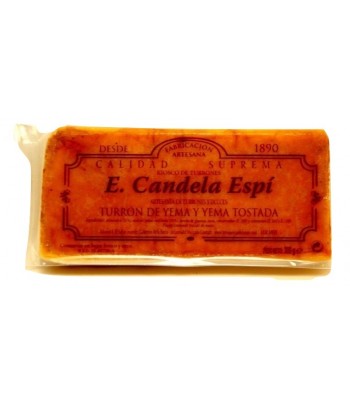
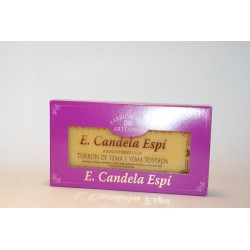
Yolk Nougat

The Nougat of Yolk of Candela Espí, has the highest quality of a unique and special elaboration process, over 100 years of experience that allows us, starting from the best raw materials and a careful craftsmanship, to create or not the most delicious nougats that you have tried. Discover a taste that will surprise you. When you already thought that the yolk nougats,could not have a more delicious taste, we improved it with all our good work.

Buy Yolk Nougat

Yolk nougat is a traditional sweet typically enjoyed during the Christmas season. If you enjoy buying yolk nougat, it's important to know everything about this delicacy: its origin, the legend behind it, its ingredients, and much more about this traditional treat of the festive season.

Origin of Turrón de Yema Quemada (Toasted Yolk Nougat)

The origin of this nougat dates back to the era of Al-Andalus, a time when a wide variety of sweets were created. Even then, both honey and almonds were commonly used, and today many pastry chefs in Spain continue to prepare both nougat and marzipan with these same traditional ingredients.

According to history, in Classical Greece there was a highly nutritious food very similar to nougat. It was made with dried fruits, almonds, and honey, and was given to athletes to provide them with energy and improve their performance during sporting routines.

This origin points mainly to the Arabian Peninsula, as there is a theory based on the treatise "De medicinis et cibir smplicibus" from the 11th century, written by an Arab physician, which makes reference to "turón".

It is important to highlight that it was the Arabs who introduced nougat to the Mediterranean region, specifically to Italy and Spain.

Some Spanish accounts indicate that nougat was created in the province of Alicante around the 15th century, during the reign of Charles V, quickly becoming a sweet of great renown.

Among the most popular nougats are the soft (blando) and hard (duro) varieties, although nowadays you can find many different flavors. Over tume, people have continued to innovate with new recipes, adding variety and enhancing this beloved sweet.

Turrón de Yema and Its Legend

There are strong suspicions that the origin of turrón de yema dates back to Catalonia, emerging from the innovative idea of a pastry chef. This pastry chef, known for making excellent sweets during the Christmas season, ran a small stall on Libretería Street around the year 1850.

His idea was to make use of all the egg yolks left over from his other creations and turn them into a pleasant dessert. To do so, he used a piece of marzipan dough that had turned out too moist.

In an effort to save the ingredients, he caramelized the marzipan with sugar and then dried it over a strong flame. This direct heat gave it a very pleasant and unique flavor, somewhat reminiscent of crème brûlée (crema catalana).

In earlier times, it was not very common to use sugar in confectionery, as honey was the main sweetener. These early attempts are believed to have taken place in the 17th century. From that point on until today, turrón de yema has become a staple wherever these types of sweets are sold, and it has never lost its charm throughout the years.

Recipe: Ingredients for Turrón de Yema

Many people are interested in knowing how this turrón is made. If you also want to learn how to prepare it, below you'll find all the ingredients you need along with the step-by-step instructions.

Classic Turrón de Yema Recipe:

  • 500g of almonds (prefetably Marcona), finely ground
  • 500g of powdered sugar
  • Natural vanilla
  • 4 to 6 egg yolks
  • 2 wafers (obleas)

How to Make Turrón de Yema

First, you need to prepare the mold where you will place the turrón. If you have a springform pan, line the base with parchment paper. If you use another type of mold, you can line it with plastic wrap, which will make it easier to remove once it's ready.

Place the water and sugar in a saucepan, then slowly heat the mixture until it starts to take on a light color and turns into a soft syrup. If you have a thermometer, make sure the temperature reaches 121°C (250°F).

Meanwhile, in a separate bowl, mix the finely ground almonds with the egg yolks, lemon, salt, and cinnamon. Once the syrup is ready, pour it gradually over the almond mixture, stirring constantly until you obtain a dense paste.

Spread this turrón mixture into your molds, ensuring the surface is even. Cover it with parchment paper and place a weight on top so it presses down evenly.

Leave the preparation to rest for at least one full day before unmolding. If you want to prepare the yema quemada (toasted egg yolk topping), use the following ingredients:

  • 150 g sugar
  • 100 ml milk
  • 20 g cornstarch
  • 2 eggs

Start by dissolving the cornstarch in about one-third of the milk and set it aside. Heat the rest of the milk with the sugar in another saucepan. While this heats up, beat the eggs with the reserved milk and cornstarch until well combined.

When the milk comes to a boil, slowly add the cornstarch mixture, whisking constantly until it thickens. Once ready, pour the mixture onto a tray lined with plastic wrap to prevent a skin from forming, and let it cool.

Finally, dust the turrón bar with powdered sugar and caramelize it with a kitchen torch. Turn the two bars, spread the yolk cream evenly with a spatula, and sprinkle with granulated sugar. Torch again to create the caramelized crust. With this final touch, your Turrón de Yema is ready to enjoy.

Registration Form For Professional Clients


Product added to wishlist
Product added to compare.